Conversational AI chatbot have moved from being a futuristic idea to a practical tool that people now rely on every day. By using a virtual agent assist for scaling customer support, businesses can respond faster, reduce wait times, and provide consistent service around the clock. Whether in virtual agent assist call centers or on digital platforms, an AI-powered chatbot helps you connect with more customers and create new opportunities for growth.
For organizations exploring advanced AI infrastructure, FlashMob Computing’s distributed computing solutions provide practical examples of handling large-scale virtual agent workloads efficiently. Developers seeking insights into high-performance AI hardware often refer to Supercomputer Box’s detailed supercomputer reviews and guides, which help optimize systems for AI chatbots and data-heavy applications.
Marketing teams can improve customer engagement using AI-powered strategies. Resources like Marketing for Customers’ guides on leveraging AI for personalized marketing campaigns demonstrate how conversational AI chatbots can streamline communication and reduce manual effort. Similarly, Marketing Runners’ step-by-step strategies for implementing virtual assistants in marketing campaigns show practical ways to scale customer support and improve responsiveness.
In financial services and client support, Expert advice on AI-driven virtual assistants explains how chatbots can automate routine tasks, reduce response times, and enhance overall customer satisfaction. Even visiting www.topfinancialresources.com/ provides insights into using AI tools to improve client communication and support.
This guide will walk you through what conversational AI chatbots are, how they work, the benefits they deliver, and how to implement them effectively in your business.
Top 10 Contact Center Solutions for Conversational AI Chatbots
Choosing the right contact center solution is essential for businesses that want to provide fast, reliable, and personalized support. Conversational AI chatbots are transforming the way companies interact with customers, and selecting a platform that integrates AI effectively can make all the difference. Here’s a list of the top 10 contact center solutions to help you scale your customer service efficiently.
1. Bright Pattern – AI-Powered Contact Center Solutions
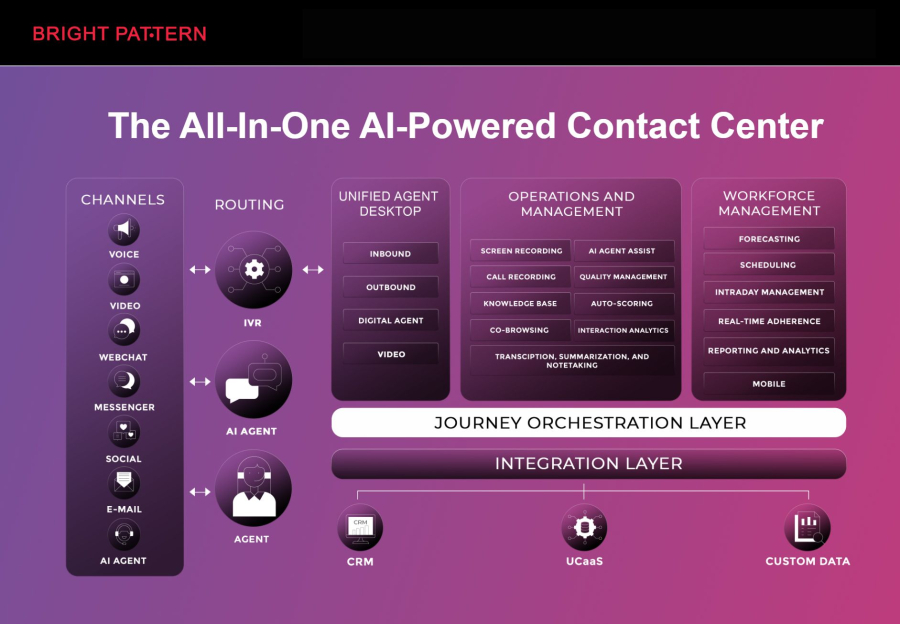
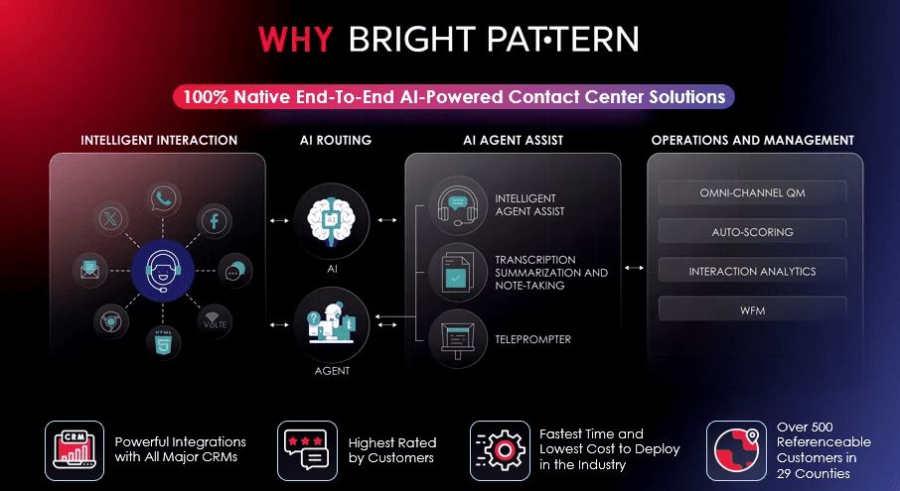
Bright Pattern is a leading AI contact center platform designed to help businesses deliver exceptional customer experiences. Its conversational AI chatbot capabilities allow companies to automate responses, handle complex interactions, and improve agent efficiency.
Key features of Bright Pattern include:
- Omnichannel support: connect with customers via voice, chat, email, SMS, and social media.
- AI-driven routing: automatically direct inquiries to the right agent or virtual assistant.
- Real-time analytics: monitor agent performance and customer interactions with detailed dashboards.
- Seamless integration: works with CRM systems and other business tools for a unified workflow.
- Scalability: supports both small businesses and large enterprises with high-volume traffic.
Bright Pattern’s platform empowers organizations to deliver intelligent, responsive, and personalized customer service, making it ideal for businesses adopting conversational AI chatbots.
2. Five9
Five9 is a cloud-based contact center solution offering AI-powered virtual agents, predictive dialing, and omnichannel routing. It helps businesses automate routine queries while providing agents with actionable insights.
3. Genesys Cloud CX
Genesys Cloud CX provides a comprehensive suite for contact center management, including AI chatbots, workforce optimization, and customer journey analytics. Its AI tools improve first-contact resolution and reduce wait times.
4. NICE inContact
NICE inContact delivers a cloud contact center platform with advanced AI features, including virtual agents, chat automation, and speech analytics. It helps businesses enhance engagement and drive operational efficiency.
5. Talkdesk
Talkdesk offers an AI-enabled contact center with intelligent routing, self-service chatbots, and performance analytics. Its solutions support personalized interactions and improve agent productivity.
6. 8x8 Contact Center
8x8 provides cloud contact center software with integrated AI chatbots, omnichannel messaging, and real-time reporting. The platform enables businesses to streamline customer support and improve response times.
7. Vonage Contact Center
Vonage offers a cloud-based contact center solution with AI-driven virtual assistants, omnichannel communication, and robust analytics.
8. Freshdesk Contact Center
Freshdesk Contact Center combines AI-driven ticketing, chatbots, multichannel support, and automation — enabling businesses to streamline customer service workflows.
9. RingCentral Contact Center
RingCentral Contact Center includes AI-driven virtual assistants, analytics, and omnichannel support. It helps organizations deliver consistent and efficient service while automating repetitive tasks.
10. Cisco Contact Center Solutions
Cisco offers contact center solutions with conversational AI chatbots, advanced routing, and real-time monitoring. The platform is ideal for enterprises seeking secure, scalable support systems.
What Is a Conversational AI Chatbot?
A conversational AI chatbot is a software application that uses artificial intelligence to understand and respond to human language in a natural, human-like way. Instead of only reacting to fixed keywords or pre-set buttons, it can interpret intent, ask follow-up questions, and carry on a fluid, multi-turn conversation.
Unlike basic rule-based bots that only follow scripts,conversational AIcan adapt its responses based on context and learn from interactions over time. That makes it ideal for customer support, sales, onboarding, HR queries, and almost any task where people typically ask questions and expect helpful answers.
Conversational AI vs. Traditional Chatbots
The term "chatbot" covers a wide range of tools. To understand the real value of conversational AI, it helps to see how it differs from traditional, rule-based bots.
| Feature | Rule-Based Chatbot | Conversational AI Chatbot |
| Understanding | Relies on keywords and rigid flows | Uses natural language understanding (NLU) to interpret intent |
| Conversation Flow | Single-turn or linear; easily breaks if user goes off-script | Multi-turn; can handle back-and-forth and context shifts |
| Personalization | Limited; often the same response for every user | Can tailor responses using user data and past conversations |
| Learning | Does not improve unless manually updated | Improves over time with training data and feedback |
| Use Cases | Simple FAQs and fixed flows | Customer service, sales, recommendations, troubleshooting, and more |
In short, conversational AI chatbots are built for flexibility, scale, and more natural interactions, making them a powerful partner for both your customers and your team.
How Conversational AI Chatbots Work
While the technology behind conversational AI can be complex, the high-level process is straightforward. Every conversation typically passes through several core steps.
1. Input: Capturing the User Message
The conversation starts when a user sends a message in text or voice. This can happen on your website, inside your app, via messaging platforms, or even over the phone.
For voice interactions, the system first converts speech to text so the AI can understand it. For text-based chat, the message goes directly into the processing pipeline.
2. Understanding: Natural Language Understanding (NLU)
The next step isnatural language understanding, where the AI attempts to interpret what the user means rather than just what they say word-for-word.
- Intent detection: Identifying the goal behind the message (for example, "track my order" or "reset my password").
- Entity extraction: Pulling out key details such as dates, product names, locations, or order numbers.
- Context handling: Considering previous messages to understand ongoing conversations.
3. Decision: Dialogue Management
Once the chatbot understands the intent, it usesdialogue managementto decide what to do next. This may involve:
- Answering a question directly.
- Asking a follow-up question to clarify.
- Looking up information in a database or knowledge base.
- Triggering a workflow, such as creating a ticket or booking an appointment.
- Escalating to a human agent when needed.
4. Response: Natural Language Generation (NLG)
After deciding how to respond, the chatbot usesnatural language generationto create a clear, human-like reply. With modern AI models, responses can sound conversational and personalized, rather than robotic or repetitive.
For voice experiences, this text is then converted back into speech using text-to-speech technology.
5. Learning: Continuous Improvement
Over time, conversational AI systems can improve based on:
- User feedback (such as thumbs up or down on responses).
- New training data from real-world conversations.
- Business updates, policy changes, or new product information.
The more conversations your chatbot handles, the more opportunities it has to become accurate, helpful, and aligned with your brand voice.
Key Benefits of Using a Conversational AI Chatbot
Why are so many organizations investing in conversational AI? The benefits show up across customer experience, operations, and revenue.
1. 24/7, Instant Support
Customers expect fast answers at any time of day. A conversational AI chatbot is always on, ready to respond in seconds. That means:
- No waiting for office hours or queue times.
- Global coverage across time zones.
- Consistent responses, no matter when a customer reaches out.
By handling common questions automatically, your chatbot keeps customers happy while your human agents focus on more complex, relationship-building tasks.
2. Lower Support Costs, Higher Productivity
As your business grows, so do customer inquiries. Hiring and training a large support team is expensive and time-consuming. A conversational AI chatbot can absorb a sizable portion of routine conversations, including:
- FAQs and policy questions.
- Order status checks.
- Account updates and simple troubleshooting.
This allows your existing team to manage more conversations with less stress. You reduce operational costs while actually improving response times and overall service quality.
3. Better Customer Experience
Customers value quick, relevant, and personalized help. Conversational AI supports this by:
- Remembering context within a conversation, so customers do not need to repeat themselves.
- Offering answers tailored to the customer’s profile or history when integrated with your CRM or user database.
- Using a brand-aligned tone of voice, so interactions feel consistent across touchpoints.
The result is smoother, more satisfying experiences that build loyalty and trust.
4. Increased Sales and Conversions
Conversational AI is not only for support. It can actively drive revenue by assisting customers throughout the buying journey. For example, your chatbot can:
- Guide visitors to the right product based on their needs and preferences.
- Answer pre-purchase questions that might otherwise cause hesitation.
- Offer personalized recommendations, bundles, or upgrades.
- Recover abandoned carts by proactively engaging visitors.
When customers get timely, helpful guidance, they are more likely to complete purchases and increase their order value.
5. Actionable Insights from Conversations
Every chat is a source of valuable data. By analyzing chatbot conversations, you can learn:
- Which questions customers ask most often.
- Where they get stuck during onboarding or checkout.
- What features or products they are most interested in.
- Common sources of frustration or confusion.
These insights feed directly into product improvements, marketing messages, and support content, helping your entire customer experience evolve.
Popular Use Cases for Conversational AI Chatbots
Conversational AI can be applied across industries and departments. Below are some of the most impactful and widely adopted use cases.
Customer Support and Self-Service
One of the strongest use cases iscustomer support. A conversational AI chatbot can handle a range of tasks, including:
- Answering product and policy questions.
- Providing order status, shipping info, and delivery updates.
- Troubleshooting common technical issues.
- Guiding customers through returns, cancellations, and exchanges.
When the issue requires human intervention, the bot can smoothly hand over the conversation, passing along context so the customer does not need to repeat their story.
Sales, Lead Generation, and Qualification
A well-designed chatbot can serve as a proactive sales assistant. It can:
- Engage visitors as soon as they arrive on your site or in your app.
- Ask qualifying questions to determine needs, budget, and timeline.
- Recommend relevant products or services.
- Capture contact information and schedule follow-up calls or demos.
This kind of automated, always-on sales support ensures you never miss an opportunity due to limited staffing or timing.
E-commerce and Retail
In e-commerce, conversational AI can function as a personal shopping assistant. Typical capabilities include:
- Helping users find products based on style, size, or use case.
- Checking stock availability and delivery times.
- Answering detailed product questions (materials, compatibility, care instructions).
- Suggesting complementary products and post-purchase add-ons.
By removing friction and uncertainty, your chatbot can directly contribute to higher conversion rates and more satisfied customers.
Banking and Financial Services
Financial institutions use conversational AI chatbots to simplify complex services while maintaining robust security. Common applications include:
- Checking account balances and recent transactions.
- Answering questions about fees, rates, and products.
- Guiding customers through loan or card applications.
- Sending alerts and reminders regarding payments or suspicious activity.
With secure authentication and careful design, chatbots make financial information more accessible without sacrificing privacy or compliance.
HR, IT, and Internal Support
Conversational AI is equally powerful inside your organization. Internal chatbots can support employees by:
- Answering HR policy questions and guiding people through benefits enrollment.
- Helping new employees onboard with checklists and common answers.
- Resolving basic IT issues, such as password resets and access requests.
- Directing staff to the right internal resources and documentation.
This reduces the load on HR and IT teams while giving employees quick, reliable help whenever they need it.
Essential Features to Look for in a Conversational AI Chatbot
Not all chatbots are created equal. When selecting or designing a conversational AI solution, focus on features that will support real-world performance and long-term value.
1. Strong Natural Language Understanding (NLU)
Your chatbot’s success depends on how well it understands user messages. Look for:
- High accuracy across different phrasings and synonyms.
- Support for your primary language(s) and any regional variations.
- Robust handling of typos, slang, and informal wording.
A strong NLU engine reduces misunderstandings and makes conversations feel much more natural.
2. Context and Multi-Turn Conversations
Real conversations rarely follow a perfect script. Your chatbot should be able to:
- Remember what was said earlier in the chat.
- Handle follow-up questions and clarifications.
- Support digressions and returns to previous topics when reasonable.
This contextual intelligence is a hallmark of truly conversational AI and a major step beyond basic bots.
3. Easy Integration with Your Systems
The most useful chatbots do more than talk; they take action. To do that, they need to connect with your existing tools, such as:
- Customer relationship management (CRM) platforms.
- Order management and inventory systems.
- Help desk and ticketing tools.
- Knowledge bases and documentation repositories.
Seamless integration allows your conversational AI chatbot to fetch information, update records, and trigger workflows automatically.
4. Omnichannel Support
Customers interact with your brand across multiple channels. Ideally, your chatbot can live wherever they are, including:
- Your website or web app.
- Mobile apps.
- Messaging platforms.
- Voice assistants or phone systems.
With omnichannel capabilities, a single conversational AI engine can power consistent experiences across many touchpoints.
5. Human Handoff and Collaboration
Even the best AI cannot handle every scenario. That is why a smoothhuman handoffis essential. Look for the ability to:
- Detect when a conversation requires a human agent.
- Transfer chats, including full conversation history and key details.
- Allow agents to see, edit, or guide AI responses if needed.
When AI and humans work together, customers get faster answers without losing the option of personal, high-touch support.
6. Analytics and Optimization Tools
To continuously improve, you need visibility into how your chatbot is performing. Valuable analytics include:
- Volume of conversations and unique users.
- Containment rate (how many queries the bot resolves without human help).
- Customer satisfaction scores or feedback ratings.
- Most common intents, questions, and failure points.
With this data, you can fine-tune your conversational flows, update content, and prioritize improvements that deliver the biggest impact.
Best Practices for Designing a Successful Conversational AI Chatbot
Launching a chatbot is not just a technical project; it is a customer experience initiative. These best practices will help you design a chatbot that people genuinely enjoy using.
1. Start with Clear Goals and Use Cases
Before you build anything, decide what success looks like. Ask questions such as:
- Which problems should the chatbot solve first?
- What metrics will define success (response time, resolution rate, sales conversions)?
- Which user journeys should be automated end-to-end?
Starting with focused, high-impact use cases helps you launch quickly and show value early.
2. Design with the User in Mind
Effective conversational design is about empathy. Consider:
- What language and terminology your users naturally use.
- How much detail they typically want in answers.
- Where they might get confused or overwhelmed.
Use simple, friendly language. Offer options when helpful, but avoid long menus that feel like work. The goal is to make the conversation feel effortless.
3. Set Expectations Early
At the start of a conversation, let users know what the chatbot can help with. A brief introduction such as, "I can help you with orders, account questions, and basic troubleshooting" sets clear expectations and guides people to successful outcomes.
Being transparent about the bot’s role also builds trust. If humans are available during certain hours, explain how and when a conversation will be transferred.
4. Make Recovery Easy When Things Go Wrong
No system is perfect. Sometimes the chatbot will misunderstand or not have the right information. Plan for these moments by:
- Offering quick ways to rephrase the question or choose from suggested topics.
- Providing a simple route to a human agent when needed.
- Acknowledging limitations instead of giving incorrect or confusing answers.
Thoughtful error handling keeps users from feeling stuck and maintains confidence in your overall support.
5. Keep Your Knowledge and Content Up to Date
A conversational AI chatbot is only as good as the information behind it. Make sure your knowledge base and FAQs are current, especially when you:
- Launch new products or features.
- Update policies, pricing, or terms.
- Introduce new promotions or campaigns.
Regular content reviews keep your chatbot accurate and aligned with your latest offerings.
6. Measure, Learn, and Iterate
After launch, treat your chatbot as a living product. Continuously:
- Review conversation logs for common questions and friction points.
- Identify intents the bot does not yet understand and add training data.
- Experiment with new flows and messages to improve completion and satisfaction rates.
Over time, these incremental improvements add up to a smarter, more capable assistant that delivers increasing value to your business.
Security, Privacy, and Trust Considerations
As conversational AI chatbots become more powerful, it is important to handle data responsibly and maintain user trust.
Protect Sensitive Information
When your chatbot deals with account data, payments, or personal details, ensure that:
- Data is transmitted and stored securely.
- Authentication steps are in place for sensitive actions.
- Access to logs and analytics is limited to authorized staff.
Security by design helps protect both your customers and your brand reputation.
Be Transparent About Data Use
Users appreciate knowing how their data is collected and used. Clearly explain:
- What information the chatbot stores.
- How that information is used to improve service.
- How users can request changes or deletion if applicable.
Clear communication around privacy helps build long-term trust with your audience.
Real-World Results: What Businesses Typically Achieve
Organizations that invest in conversational AI chatbots often see meaningful improvements across several key metrics. While exact numbers vary, common outcomes include:
- Reduced response timesfrom minutes or hours down to seconds.
- Higher self-service rates, with a large portion of inquiries resolved without human intervention.
- Lower support costsdue to fewer repetitive tickets for your agents.
- Improved customer satisfactionthanks to faster, more consistent answers.
- Increased revenuefrom better lead capture and more confident, informed buyers.
These benefits compound over time as your chatbot learns, your team optimizes flows, and more channels are brought into the experience.
Getting Started with Conversational AI Chatbots
Implementing conversational AI is an exciting opportunity to modernize your customer experience. You can move forward in stages:
- Identify top use casessuch as customer support FAQs or common sales questions.
- Map user journeysand define what success looks like for each one.
- Select a platform or partnerthat offers strong NLU, integrations, and analytics.
- Design your conversation flowsand create clear, helpful content.
- Launch a pilotwith a subset of traffic and gather feedback.
- Iterate and expandto new use cases, channels, and languages as you see results.
By starting focused and optimizing over time, you can steadily build a conversational AI assistant that feels like a natural extension of your team.
Conclusion: Turn Conversations into a Competitive Advantage
Conversational AI chatbots are reshaping how businesses communicate with customers and employees. They combine the speed and scale of automation with the warmth and flexibility of natural conversation.
When thoughtfully designed and continuously improved, a conversational AI chatbot can:
- Deliver instant, 24/7 support.
- Boost sales and conversions by guiding buyers in real time.
- Empower teams to focus on high-value, human-centered work.
- Provide rich insights that fuel smarter decisions across your organization.
Now is an ideal time to explore what conversational AI can do for your business. With clear goals, user-centric design, and a commitment to ongoing improvement, your chatbot can quickly become one of your most valuable digital assets.
